
Fine Art Principles & Criteria
In the introduction to this book, I made a claim that sounds simple but carries a lot of weight: art is consciousness manifested. It's the definition everything else in this project is built on. But a definition like that raises an obvious follow-up question — one that matters just as much to a reader with a camera as it does to a philosopher. If art is really about authentic, subjective experience, what do we do with all the things we normally call "good photography"? Composition. Contrast. Color harmony. The rules we teach in every workshop, every YouTube tutorial, every textbook.
Are those rules part of art — or are they something else entirely?
This chapter is where I try to answer that. And the answer splits beauty into two kinds that behave very differently.
Part OneTwo Kinds of Beauty
Beauty isn't one thing. I've come to think of it as two separate currents that run through any strong photograph, and confusing them is where a lot of well-intentioned artists get stuck.
The first is what I call extrinsic beauty — the learned, shareable, teachable layer. Compositional balance. The way contrast draws the eye. Color relationships that most human eyes respond to in fairly predictable ways. This is beauty by way of convention: patterns that have proven, across time and culture, that they reliably catch attention and hold it. It's real, it's useful, and — importantly — it's largely universal enough to teach. That's exactly why it's teachable: it doesn't depend on knowing the artist's inner life at all.
The second is intrinsic beauty — and this is the one that can't be taught, because it isn't a rule at all. It's what happens when a genuinely authentic expression of your own conscious experience reaches someone else and moves them. You can't manufacture it with a technique. You can only arrive at it by being honest about what you actually experienced, and skilled enough to get that experience onto the frame intact. Other chapters in the book will give substantial practical suggestions how to achieve that. Preview summaries of that will also be posted on this website in the form of booknotes.
Here's the part I think matters most for anyone making work right now: you don't have to choose between them. The strongest photographs I know use extrinsic beauty as an on-ramp — a way of drawing someone in with something visually familiar and satisfying — so that they stay long enough to encounter whatever is genuinely, authentically yours underneath it. Extrinsic beauty gets the door open. Intrinsic beauty is what's waiting on the other side of it.
Part TwoThree Steps Away From Reality
So if extrinsic beauty is the craft side of the equation — the deliberate, learnable moves that create it — where does that craft actually begin? Not at the edit, and not even at the moment of composing a frame. It begins earlier than that, with the camera itself. One of the premises in the book, supported by experiential evidence in neuroscience, is that the more steps you move away from reality, the more abstract, and the more it will be interpreted as beautiful.
Here's something worth sitting with: the moment you raise a camera to your eye, you have already left reality behind. Not metaphorically — mechanically.
- A photograph is a scaled-down version of whatever stood in front of the lens.
- A photograph flattens a three-dimensional world into two dimensions.
- A photograph isolates one framed, singular perspective out of a much wider scene.
Three departures from reality, and you haven't made a single creative decision yet. That's simply what a camera does.
Which reframes the whole question of technique. The question was never whether to distort reality — you already are, unavoidably, the instant you press the shutter. The real question is whether you let those three departures happen by accident, or whether you take them somewhere on purpose.
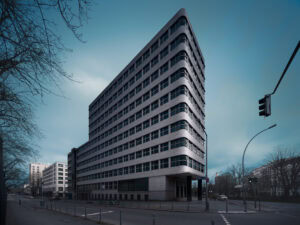
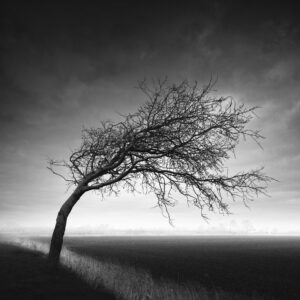
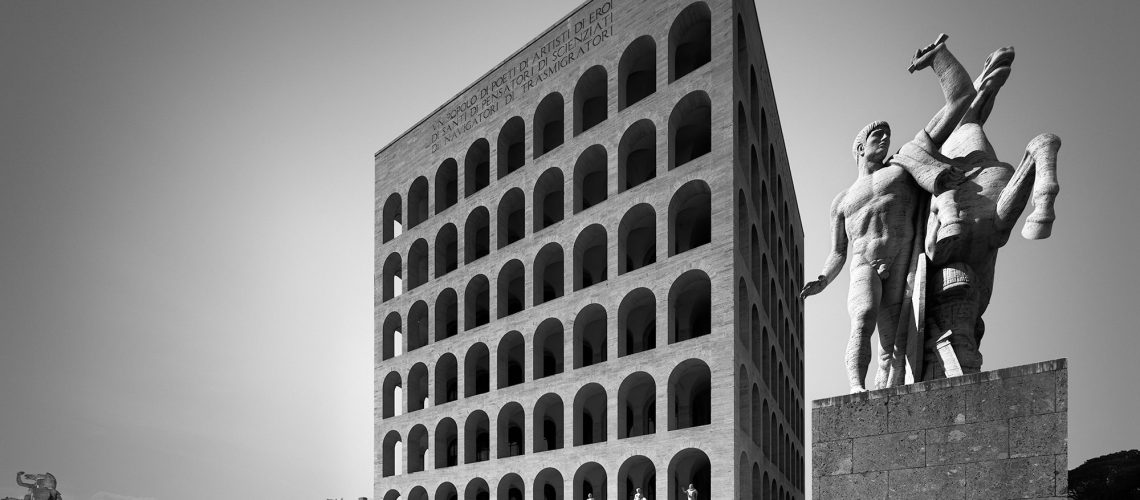
That's where a fourth kind of decision enters — the deliberate ones. Choosing black and white over color. Choosing a long exposure that stretches a moment no eye ever actually witnessed. Exaggerating depth and presence between foreground and background. Getting physically closer to a building until the perspective itself becomes dramatic. None of these are neutral, technical choices. Each one is a further, intentional step away from documentation and toward interpretation — your interpretation, specifically. This is extrinsic beauty in practice: not a single rule, but a whole set of deliberate departures from the raw scene, each one chosen to draw the viewer further in.
Part ThreeFigure and Ground
One principle from this chapter that I keep coming back to, because it quietly underlies almost every other compositional decision, is the relationship between figure and ground — a concept I've borrowed and built on from classic art theory (Mark Getlein's formulation, for those who want to trace it further). The figure is the shape your eye detaches from its surroundings and focuses on. The ground is everything else — the visual context the figure stands out from.
Once you can see that relationship clearly, a set of very practical rules follows almost automatically. The eye goes to the highest contrast and the brightest light — that's your figure, whether you planned it or not. The darkest tones tend to sit closest to the viewer, in and around the figure. The lowest contrast, the least detail, belongs farthest away, in the ground. And the sense of "presence" — that feeling of dimensional depth in a still, flat image — comes from subtle, deliberate transitions between dark and light across those planes.
None of this is decoration. It's how you direct a viewer's attention before they're even consciously aware they're being directed.
Where This Leaves UsTwo Layers, One Photograph
Put together, this chapter's job is to take the abstract claim from the introduction — art as consciousness manifested — and make it operational. Extrinsic beauty is the craft: composition, contrast, figure and ground, all learnable, all teachable, all genuinely useful for pulling a viewer into the frame. Intrinsic beauty is the reason any of it matters at all — the authentic, unrepeatable experience that extrinsic beauty was only ever in service of. How to identify and express intrinsic beauty will be discussed in detail in other book chapters of which a preview will be available on my website.
A technically flawless photograph with nothing authentic behind it will draw the eye and let it go. A deeply authentic experience with no craft behind it may never draw the eye at all. The work — the whole project of this book, really — lives in the space where both are present at once.
What's here is the short version. The forthcoming book will go further — with the full figure-ground breakdown, the tonal composition principles in detail, and how extrinsic and intrinsic beauty actually work together across a real body of work.
If you'd rather put these principles into practice with a camera in hand, that's exactly what the Netherlands–Belgium Fine Art Architecture Premium Workshop is for. Over four days in Amsterdam, Rotterdam, and Antwerp (November 5–8, 2026), we'll work through composition, contrast, and presence on real buildings, in real light — not just in theory. Early Bird applies until August 14, 2026.